Introduction
Artificial Intelligence (AI) has become a buzzword in tech, business, and everyday life. Yet, for many people, the term still feels abstract and intimidating. In this guide we’ll break down the core ideas behind What Is AI?, explain how it works in plain language, and show you real‑world examples that illustrate its power. Whether you’re a student, a professional, or just curious, this article will give you a clear, beginner‑friendly foundation.
What Is Artificial Intelligence?
AI is the science of building computer systems that can perform tasks that normally require human intelligence. These tasks include:
- Learning from data – improving performance over time without explicit re‑programming.
- Understanding language – interpreting and generating human speech or text.
- Recognizing images – identifying objects, faces, or scenes.
- Making decisions – choosing actions based on data and goals.
In short, AI lets machines think and act in ways that mimic human cognition.
How Does AI Work? The Machine‑Learning Loop
Most modern AI relies on machine learning (ML), a process that trains a model on data. The loop looks like this:
- Collect Data – Gather examples (images, text, numbers).
- Train the Model – Use algorithms to find patterns and build a predictive function.
- Validate & Tune – Test on new data, adjust parameters, and improve accuracy.
- Deploy – Integrate the model into an application that makes real‑time predictions or decisions.
Example: A spam filter learns from thousands of e‑mails labeled as “spam” or “not spam.” Over time it becomes better at spotting new spam messages.
Types of AI
| Type | Description | Everyday Example |
|---|---|---|
| Artificial Narrow Intelligence (ANI) | Designed for a single task. | Voice assistants (Siri, Alexa), recommendation engines on Netflix. |
| Artificial General Intelligence (AGI) | Hypothetical system that can perform any intellectual task a human can. | Still a research goal; no commercial AGI exists. |
| Super‑AI | Hypothetical AI that surpasses human intelligence. | Science‑fiction concept; not yet realized. |
Most AI you encounter today is ANI, focused on specific, well‑defined problems.
Key Technologies Behind AI
- Machine Learning – Algorithms that learn from data.
- Deep Learning – Neural networks with many layers that excel at vision, speech, and language tasks.
- Natural Language Processing (NLP) – Enables machines to understand and generate human language.
- Computer Vision – Lets computers interpret visual information.
- Generative AI – Creates new content (text, images, music) based on learned patterns.
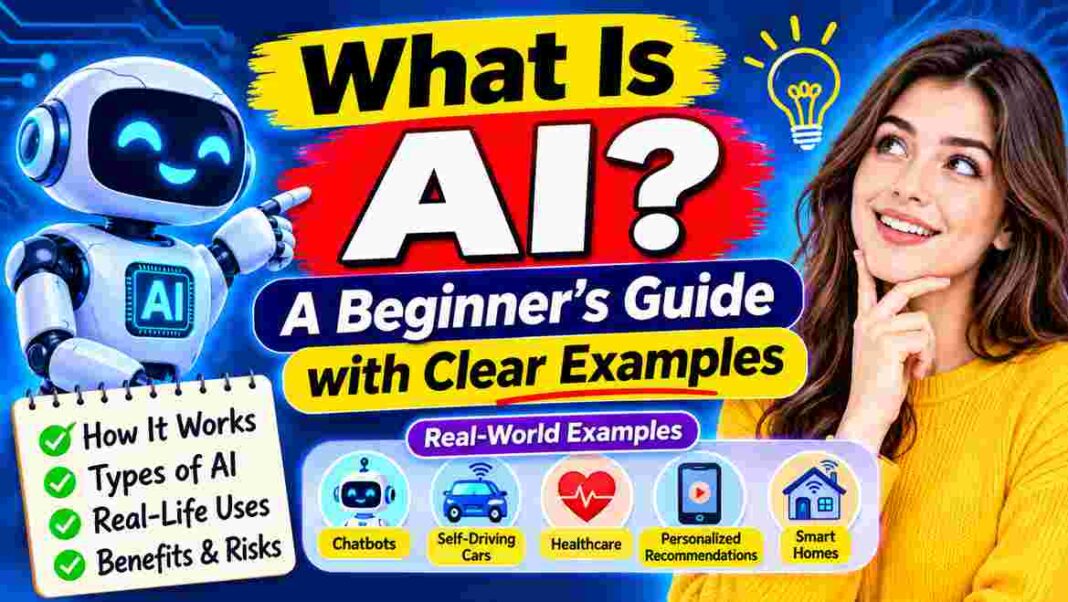
Practical Examples of AI in Daily Life
| Domain | AI Application | What It Does |
|---|---|---|
| Entertainment | Streaming recommendations | Suggests movies or songs you’ll like. |
| Healthcare | Diagnostic imaging | Detects tumors in X‑ray scans. |
| Finance | Fraud detection | Flags unusual transactions in real time. |
| Retail | Chatbots | Handles customer queries 24/7. |
| Transportation | Autonomous vehicles | Navigates roads without human input. |
These examples show how AI improves efficiency, personalization, and safety across industries.
Benefits of AI
- Automation of repetitive tasks – frees humans for creative work.
- Faster, data‑driven decisions – reduces error and bias when properly designed.
- 24/7 availability – chatbots and monitoring systems never sleep.
- Scalability – AI can process millions of data points instantly.
Challenges and Ethical Considerations
- Bias & Fairness – Models can inherit biases present in training data.
- Privacy – AI often requires large datasets that may contain personal information.
- Job Displacement – Automation can replace routine roles.
- Transparency – Understanding how a model makes decisions is crucial for trust.
Responsible AI development involves clear governance, diverse data, and ongoing monitoring.
Getting Started with AI
- Learn the Basics – Python, statistics, and linear algebra are foundational.
- Explore Online Courses – Many platforms offer beginner‑friendly AI tracks.
- Build Small Projects – Start with a spam filter or image classifier.
- Join Communities – Forums, meetups, and open‑source projects accelerate learning.
Frequently Asked Questions
| Question | Answer |
|---|---|
| What is the difference between AI and machine learning? | AI is the broader concept of machines performing intelligent tasks; machine learning is a subset that teaches machines from data. |
| Can anyone learn AI? | Yes—basic programming and math skills are enough to start, and many free resources exist. |
| Is AI dangerous? | Like any technology, AI can be misused. Ethical guidelines and regulation help mitigate risks. |
| Will AI replace all jobs? | AI will automate routine tasks, but it also creates new roles that require human oversight and creativity. |
Conclusion
Artificial Intelligence is no longer a distant future concept; it’s already shaping how we shop, travel, and communicate. By understanding the fundamentals—what AI is, how it learns, and where it’s applied—you can start to see its impact in everyday life and consider how it might fit into your own career or projects. The field is evolving rapidly, but the core ideas remain the same: data, patterns, and intelligent decision‑making.